

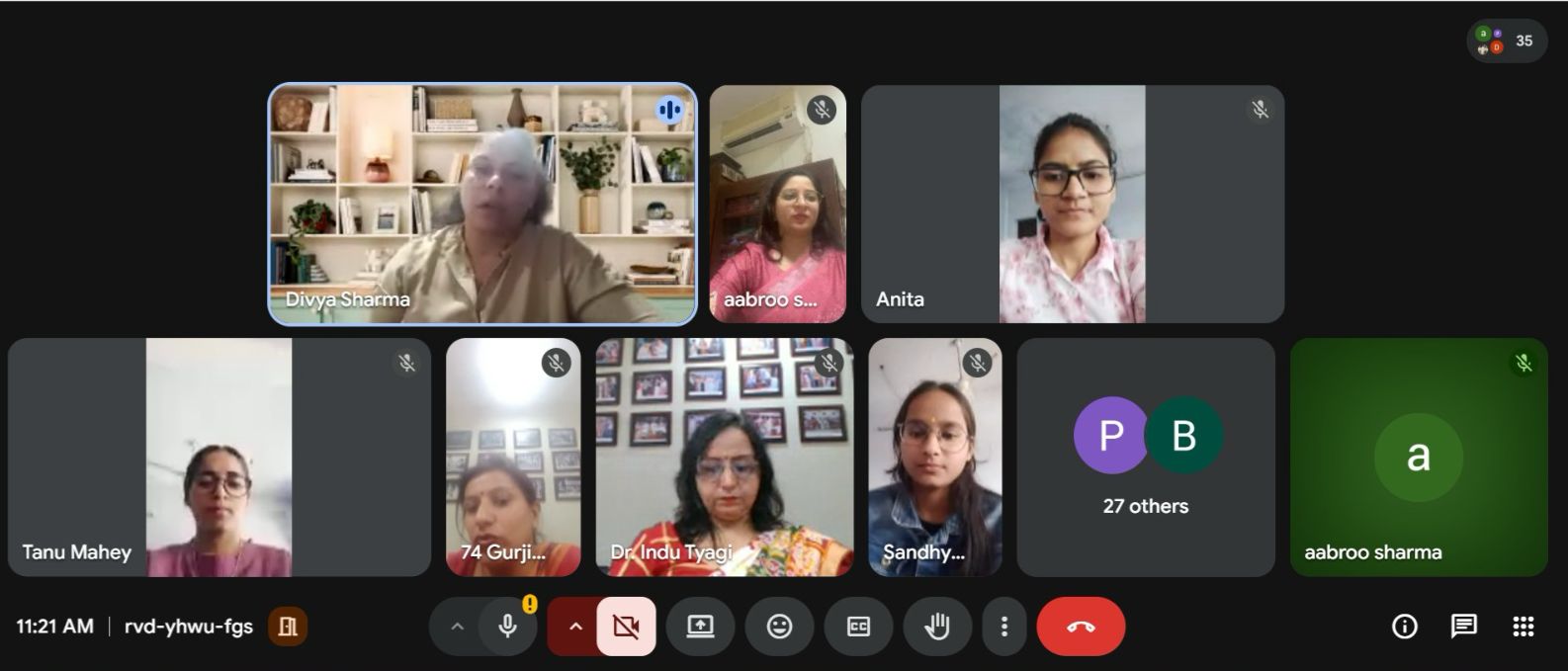
Jalandhar April 25 (Jaswinder Singh Azad)- The Department of English of PCM S.D. College for Women, Jalandhar, organised an International Webinar on the topic “From ‘Arvo’ to ‘Timepass’: What Slang Reveals About Australian and Indian Cultures.” The session was conducted by Dr Divya Kalia Sharma, Registered Migration Agent (RMA), OMARA, Australia, and a Migration Consultant specialising in Australian visa services.
The webinar was conceived as an exploration of how informal linguistic registers function as cultural texts, offering insight into everyday life.
At the centre of the discussion was the proposition that slang operates as a dynamic linguistic layer that resists rigid codification. It evolves with generational shifts, digital communication, and changing social environments, often carrying traces of hybridity and cultural borrowing. In both Australian and Indian contexts, such expressions reveal not only patterns of speech but also attitudes towards leisure, work, hierarchy, and interpersonal relationships, thereby making slang an important lens for examining contemporary culture.
Dr Sharma drew attention to the cultural relevance carried by seemingly casual expressions
Dr Sharma drew attention to the cultural relevance carried by seemingly casual expressions, examining how slang operates as a site of identity formation and social positioning. Through a comparative lens, she mapped Australian and Indian usages, demonstrating how words such as “arvo” and “timepass” are not merely linguistic shortcuts but reflective of differing temporal sensibilities, social rhythms, and communicative ease. Her observations foregrounded the idea that language, even in its most unguarded forms, encodes patterns of belonging and cultural negotiation.
The discussion prompted participants to reconsider the boundaries between formal and informal discourse, and to recognise slang as a legitimate area of linguistic inquiry. The interaction that followed was marked by thoughtful questions, particularly around the implications of such language use in academic, professional, and transnational contexts. The session thus extended beyond description to invite analytical engagement.
President Shri Naresh Budhia, Senior Vice President Shri Vinod Dada, other members of the managing committee and Principal Dr Pooja Prashar acknowledged the speaker’s contribution with appreciation, noting the clarity and precision with which the subject was addressed. They observed that such academic engagements strengthen the institution’s emphasis on critical inquiry and broadened perspectives, while also reinforcing its commitment to creating platforms that connect classroom learning with wider cultural frameworks.