

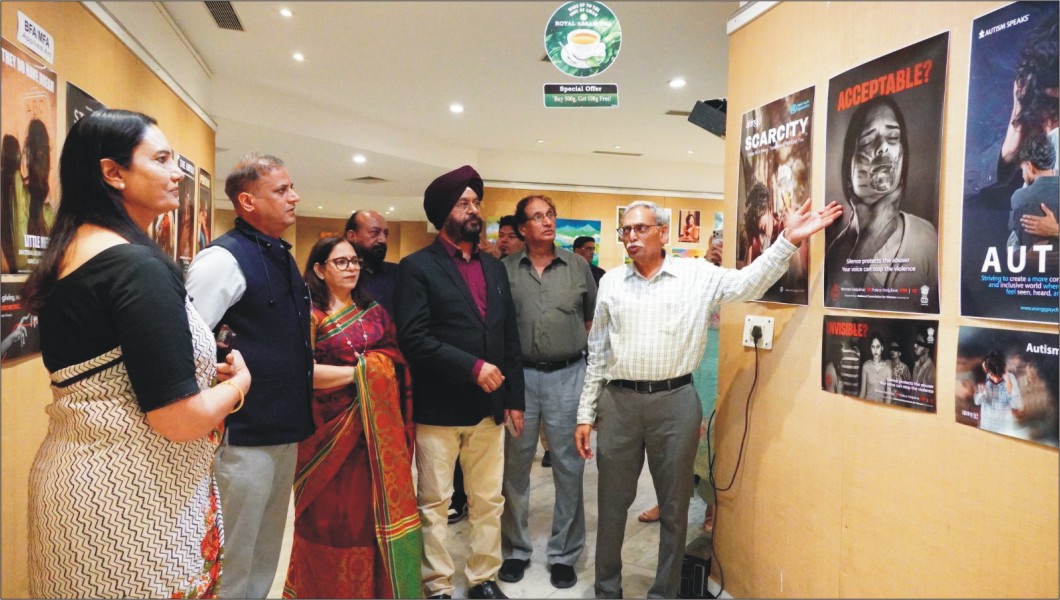
Jalandhar October 19 (Jaswinder Singh Azad)- Beautiful glimpses of Punjab’s rich cultural heritage were showcased during ‘Rangla Punjab’—a three-day live painting workshop organised by Apeejay Education, in a joint collaboration between the North Zone Cultural Centre and the Punjab Lalit Kala Akademi. The workshop was organised at Apeejay College of Fine Arts, Jalandhar.
Mr. Surinder Singh, Commissioner of the Jalandhar Municipal Corporation, attended the valedictory ceremony of this live painting workshop, ‘Rangla Punjab’, as the chief guest, while Mr. Swarnjit Singh ‘Savi’, Chairman of the Punjab Arts Council, was the esteemed Guest of Honour.
Welcoming Mr. Surinder Singh, Dr. Sucharita Sharma, Director of Apeejay Education, remarked that the dedication and sincerity with which he serves the city of Jalandhar are truly commendable. Welcoming Shri Swarnjit Singh Savi, she remarked that it is a matter of pride that he is an alumnus of Apeejay. He is not only an accomplished Punjabi poet and thinker but also a creative artist and a profound intellectual. He is performing his duties as the Chairman of the Punjab Arts Council with great distinction. She also welcomed the Principal of Apeejay College of Fine Arts, Dr. Neerja Dhingra with grace.
During these three days, all the artists, viewing Punjab through their own unique perspectives, created imaginative works, capturing the cultural, social, and natural beauty of Punjab on canvas through their colors.
Shri Jaspal Singh’s painting captures the beauty of Punjab—a land of fairs
Shri Jaspal Singh’s painting captures the beauty of Punjab—a land of fairs. He illustrates how the arrival of a fair fills the entire village atmosphere with joy, while children entertain themselves by playing various games.
In the paintings of Shri Anil Gupta, the vibrant colors of Punjab, the carefree nature of the Punjabi people, the fields and threshing grounds, and the beauty of natural hues have been presented in a highly impressive and abstract manner.
In her painting, Smt. Guranjan Pal depicted the natural beauty of Punjab’s villages, the depth of emotions, scenes of women on their way to fetch water, enjoying themselves on swings, and the harmonious relationship between humans and birds.
Dr. Jeevan Dureja has presented the rainbow-hued colors of the land of Punjab and the captivating beauty of the cultural activities in its villages through her painting.
Bringing the vision of a ‘Golden Punjab’ to life, Dr. Rimpy Aggarwal depicted lush, swaying golden fields as the foundation for all of Punjab’s culture. Through her painting, she conveyed the message that these very fields and farmlands serve as the core basis for the joy found in our Giddha and Bhangra, as well as for the folk life of Punjab.
Shri Rajesh Kalsi made the concept of ‘Maha Punjab’ (Greater Punjab) the basis of his painting
Shri Rajesh Kalsi made the concept of ‘Maha Punjab’ (Greater Punjab) the basis of his painting. Tracing the history of Punjab—from the Harappan civilization through regions such as Kabul, Kashmir, Haryana, and Punjab—he highlighted the pivotal role of the ox in agriculture. He also depicted how, due to the growing influence of technology, the ox now appears to stand alone, and yet, its existence and significance remain intact.
Dr. Gagan Gambhir created a beautiful painting, adorning the cultural heritage of Punjab, the aura of Gurdwaras, the diversity of colors, and the captivating patterns of Phulkari with the hues of his imagination.
Through her painting, Smt. Suruchi Sharma depicted not only the economic prosperity and affluence of Punjab but also its musical heritage, rhythm, and the captivating beauty of Phulkari.
Shri Pawan Kumar has beautifully depicted the rich musical heritage of Punjab in his painting by incorporating instruments such as the tumbi and dhol. Shri Harinder Bhatti has presented a captivating portrayal of Punjabi culture, with the Punjabi turban as the central element.
Thus, the three-day live painting workshop, ‘Rangla Punjab,’ proved to be an excellent platform for showcasing Punjab’s rich cultural heritage, folk life, natural beauty, agriculture, music, and artistic traditions through the medium of color. Beyond nurturing the creative talent of the artists, this workshop served as a significant initiative to bring Punjab’s unique identity and heritage to the public through the medium of art. At this closing ceremony, Mr. Sumit Dua, President of the Punjab Lalit Kala Akademi, thanked the chief guest, special guests, and all those present, stating that such artistic initiatives play a vital role in preserving and promoting Punjab’s rich cultural heritage, as well as in passing it on to the new generation.