

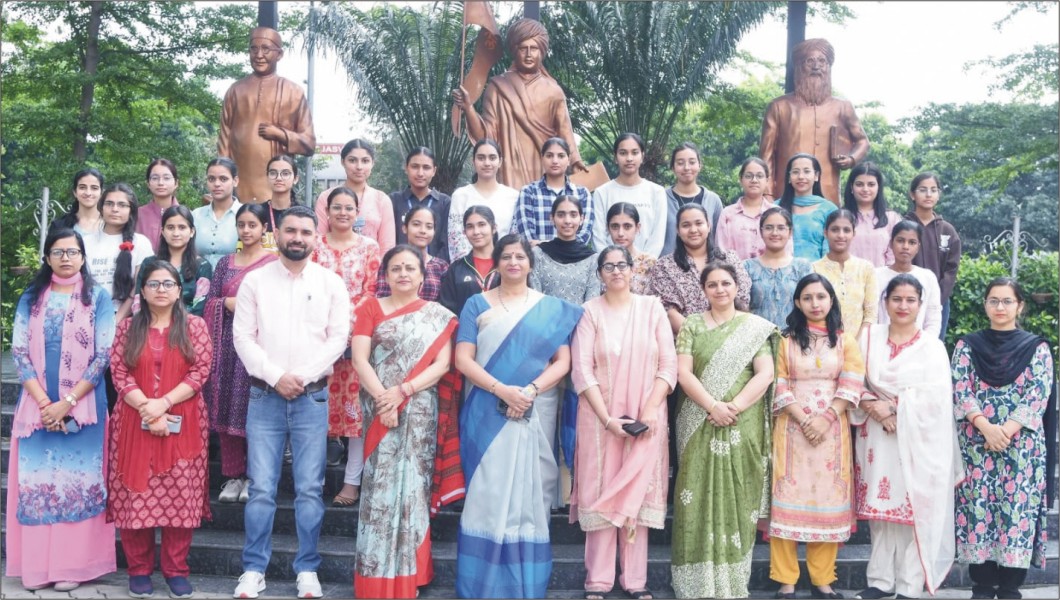
Jalandhar April 27 (Jaswinder Singh Azad)- Hans Raj Mahila Maha Vidyalaya, Jalandhar, organized a one-day Seminar-cum-Workshop on “Unveiling Atomic Structure through Zeeman Effect” under the DST-Curie grant. The event was jointly conducted by the Chandrayaan Vipnet Club of the PG Department of Physics and the R. Venkatraman Chemical Society of the PG Department of Chemistry. The session aimed to deepen students’ understanding of atomic structure and its experimental foundations. The resource person for the seminar was Dr. Daljit Kaur, Assistant Professor in Physics at DAV University, Jalandhar. The programme witnessed enthusiastic participation from both undergraduate and postgraduate students.
Principal Dr. (Mrs.) Ekta Khosla, along with faculty members from the Physics and Chemistry departments, extended a warm welcome to the guest by presenting a planter. Dr. Saloni Sharma, Head of the PG Department of Physics, introduced the theme of the seminar and emphasized its academic relevance. Mrs. Deepshikha, Head of the PG Department of Chemistry, formally introduced the resource person. Dr. Sushil Kumar highlighted the initiatives and activities undertaken by the Chandrayaan Vipnet Club.
The workshop segment featured a detailed demonstration of the Zeeman Effect apparatus
In her expert lecture, Dr. Daljit Kaur elaborated on the theoretical aspects of the Zeeman Effect, explaining the normal and anomalous splitting of spectral lines under the influence of a magnetic field. She also discussed its wide-ranging applications, including the determination of magnetic fields of celestial bodies like the Moon, the study of atomic energy levels, and its role in magnetic resonance techniques. The workshop segment featured a detailed demonstration of the Zeeman Effect apparatus. Participants were guided through its construction, working principles, and calibration methods.
The hands-on session enabled students to practically observe how magnetic fields affect atomic energy levels and spectral emissions, thereby strengthening their conceptual clarity. The session remained highly interactive, with students actively engaging in discussions and resolving their queries. The programme concluded with a formal vote of thanks, expressing gratitude to Dr. Daljit Kaur for her enlightening session and to all participants for their active involvement. The seminar-cum-workshop proved to be highly informative and enriching, significantly enhancing the academic and experimental understanding of the attendees.