

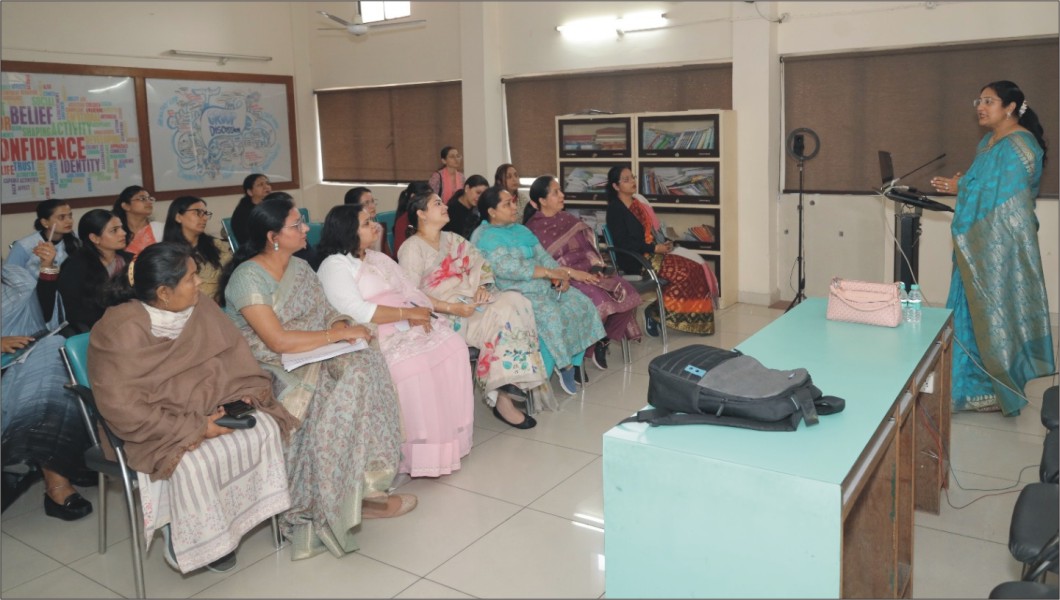
Jalandhar March 3 (Jaswinder Singh Azad)- The PG Department of Commerce and Management of PCM S.D. College for Women, Jalandhar in collaboration with the Research Committee and IPR Cell, successfully organised a Five-Day National Level Faculty Development Programme (FDP) on “New Innovative Practices in Teaching and Research” from 23rd February 2026 to 27th February 2026.
The programme aimed to enhance the teaching, research, and technical skills of faculty members through expert lectures and practical insights. The objective of the programme was to equip the faculty members with contemporary tools and techniques in the field of teaching, research methodology, academic writing, and technology integration. The programme was designed to bridge the gap between traditional academic practices and the evolving demands of modern education and research.
On the first day, an expert lecture on ‘Research Grant Writing: Translating Ideas into Grant Proposals’ was delivered by Dr. Arfat Ahmed Sofi, Assistant Professor Department of Economics and Finance, BITS, Pilani – K.K. Birla Goa Campus. He highlighted the importance of quality research as the foundation of a successful grant proposal. He listed several Indian funding agencies providing grants-in-aid, including ICSSR, RBI, UGC, Ministry of Education, NABARD, and many more. Regarding the budget, he emphasized that researchers must clearly justify the amounts with limits such as research staff not exceeding 45% of the total budget, fieldwork 35%, equipment 12%, and contingency 5%.
The second day featured an insightful session by Professor Dr. Pooja Bhasin
The second day featured an insightful session by Professor Dr. Pooja Bhasin, Head of the Computer Science Department at LKCTC, on ‘Business Intelligence Tool: Tableau’. She delivered the session on Tableau, a Business Intelligence Tool where she highlighted the exponential growth of data in the digital era and emphasized data visualization’s role in informed research and business decisions. The hands-on demo of Tableau Public covered data dimensions, measures, aggregation functions, and visualization techniques.
On the third day, Dr. Rekha Handa, Assistant Professor, University Business School, Guru Nanak Dev University, Amritsar delivered an enlightening lecture on ‘Exploring the World of Open-Source Software’. She emphasized the importance of good quality data and explained how open-source tools have made data analysis more accessible and affordable.
She highlighted how open-source tools empower researchers by providing access to data analysis capabilities, reducing dependence on hired experts and enables resource-poor researchers to participate in the global research ecosystem. She encouraged the faculty members to keep pushing boundaries, reminding them that every breakthrough starts with curiosity, so one must keep going and emphasized that they had the power to unlock new discoveries.
The fourth day was dedicated to Strengthening Research Manuscripts
The fourth day was dedicated to “Strengthening Research Manuscripts: Addressing Structural and Theoretical Gaps” led by Dr. Robin Kaushal, Assistant Professor, Sri Aurobindo College of Commerce and Management, Ludhiana. She highlighted key aspects of crafting effective research papers, including understanding logic and structure, identifying impactful qualities, and streamlining writing. She addressed common structural and conceptual problems, mistakes researchers make, and ways to avoid them. She emphasized maintaining novelty and originality, discussing reasons for manuscript rejection and guiding participants to improve structure, theoretical framework, methodology, and academic writing style.
On the fifth and concluding day, Dr. Mansaf Alam, Former Dean, Alumni Affair, Professor, Department of Computer Science, Jamia Millia Islamia, New Delhi delivered a forward-looking lecture on Artificial Intelligence Tools for Teaching and Research. He demonstrated various AI tools useful for creating presentations, quizzes, lesson plans, and assessments, highlighting how AI can significantly enhance teaching efficiency and research productivity.
The resource person covered various AI tools namely, Gamma AI an AI-powered platform designed to facilitate the creation of presentations, documents, chatbots and websites etc., Napkin AI an AI-powered visual collaboration tool that lets users create and share ideas, diagrams, and presentations and is designed for brainstorming and collaboration, offering features like mind maps, flowcharts, and sticky notes was also given.
The programme witnessed an active participation of around 75 faculty members
At the conclusion of the programme, Dr. Kuljeet Kaur, Incharge of the Research Committee, Convenor of the FDP, extended the vote of thanks and presented a brief report summarising the key highlights and outcomes of all five days of the FDP. The programme witnessed an active participation of around 75 faculty members, who engaged enthusiastically with the speakers and raised queries that were addressed satisfactorily by the respective experts.
Overall, the FDP proved to be highly informative and enriching, providing valuable insights into innovative teaching methods, modern research tools, academic writing, and the effective use of technology in education.
President Shri Naresh Budhia, Senior Vice President Shri Vinod Dada, other members of the managing committee and Principal Dr Pooja Prashar applauded the Department and the Committe for contributing to the professional development of the faculty members and is expected to have a lasting impact on the quality of teaching and research at the institution.