

India Prepares Scientific Roadmap for the World’s Largest Radio Telescope Project
Government of India Approves ₹1,250 Crore for Radio Telescope Project
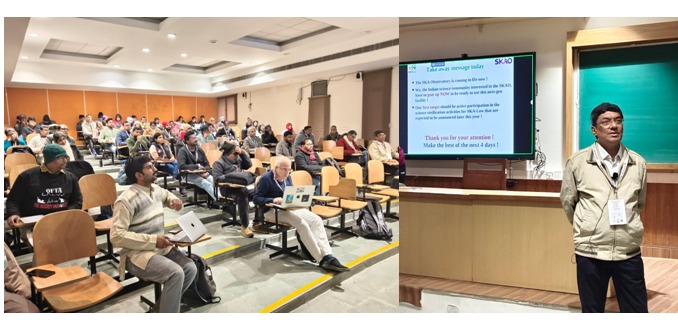
MOHALI, January 16 (Jaswinder Singh Azad)- The national science meeting titled “India and the SKA: Preparing for a Transformative Era in Astrophysics” commenced on 15 January at IISER Mohali. Organised by the SKA-India Consortium (SKAIC) in collaboration with IISER Mohali, this landmark event brings together nearly 100 of the nation’s leading astronomers, researchers, and students to chart India’s scientific roadmap for the world’s largest radio telescope.
Coming on the heels of India formally joining the Square Kilometre Array Observatory (SKAO) as a full member in July 2024, the meeting serves to pivot the national community from infrastructure planning toward scientific execution. The Government of India has approved participation in this international mega-science project with a substantial commitment of ₹1250 crore, funded jointly by the Department of Atomic Energy (DAE) and the Department of Science and Technology (DST), with the National Centre for Radio Astrophysics (NCRA-TIFR) serving as the nodal institute.
The four-day summit features a rigorous programme of over 40 technical talks
The four-day summit features a rigorous programme of over 40 technical talks, 25 poster presentations, and interactive discussion sessions. The scientific agenda covers a diverse range of topics, from the study of our own Sun, and stars in our Galaxy to the mystery of Fast Radio Bursts, the evolution of distant galaxies, and the detection of the first stars in the early Universe.
Prof. Yashwant Gupta, Centre Director of NCRA-TIFR and India’s Science Representative on the SKAO Council, emphasized the urgency of the gathering:
“With Science Verification data from the SKA telescopes expected as early as next year, we have reached a critical juncture. This is the optimal moment for the Indian scientific community to unite and strategise. Our goal is to ensure that our researchers, from senior faculty to PhD students, are prepared to utilise this transformative data with maximum efficiency and impact, further strengthening India’s importance in the field of global radio astronomy.”
These young scientists represent the future users of the SKAO
Prof. Tirthankar Roy Choudhury of NCRA-TIFR, who is Chair of the Scientific Organising Committee of the meeting said:
“The meeting serves as a vital bridge between generations of scientists. While senior experts lead the strategic discussions, a significant portion of the participants are early-career researchers and PhD students. These young scientists represent the future users of the SKAO, and the meeting is designed to provide them with the training and collaborative networks necessary to lead international Key Science Projects.”
Prof. Jasjeet Singh Bagla from IISER Mohali pointed out that the first Science with the SKA meeting in India was held at IISER Mohali in March 2014 on the sidelines of the annual meeting of the Astronomical Society of India, and this led to the formation of the consortium a year later. So it is fitting that the first science meeting of the consortium is taking place in the same place.
About the SKA-India Consortium (SKAIC)
The SKA-related activities in India are coordinated by the SKA-India Consortium, which comprises 24 member organizations, including premier research institutes, IITs, IISERs, and major universities. The SKAIC oversees the scientific, technical, training, and outreach efforts of the country, ensuring a unified national approach to the SKA project.
About the SKAO and India’s participation
The Square Kilometre Array Observatory (SKAO) is an international effort to build the world’s largest and most sensitive radio telescopes in South Africa and Australia. India’s participation, funded by the DAE and DST, includes significant contributions to the “brain” of the telescope, the sophisticated software and control systems required to process unprecedented amounts of cosmic data.