

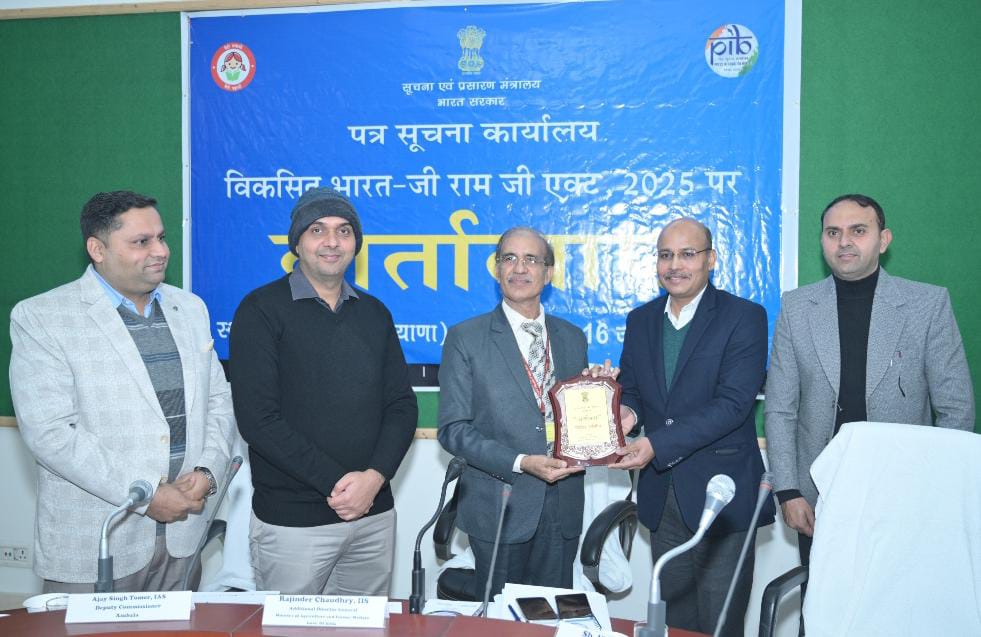
The new law strengthens a modern, accountable, and infrastructure-centric framework: Ajay Singh Tomer, Deputy Commissioner
Viksit Bharat – G Ram G Act – an important step towards fulfilling the dream of a Developed India – Rajinder Chaudhry
The new law establishes a framework of transparency, accountability, and social security: Rajinder Chaudhry
Jalandhar January 16 (Jaswinder Singh Azad)- The Additional Director General (Rural Development), Press Information Bureau, Ministry of Information and Broadcasting, Shri Rajinder Chaudhry said that the ‘Viksit Bharat – G Ram G’ Act is an important step towards fulfilling the dream of a Viksit Bharat and a significant step towards building self-reliant villages in India. Addressing a dialogue organized in Ambala, Haryana, on the Viksit Bharat–G Ram G Act 2025, the Additional Director General, Press Information Bureau, Delhi, Shri Rajinder Chaudhry, while providing detailed information on the various provisions of this ambitious initiative, said that this law is a concrete effort to strengthen employment generation, expand basic facilities, and promote self-reliance in villages.
He said that under the earlier system of MGNREGA, there was a guarantee of 100 days of employment, but in many places neither was work available on time nor were wages paid on time. Terming this a matter of serious concern, he said that to remove such shortcomings and eliminate corruption, the government has introduced reforms through the ‘Viksit Bharat – G Ram G’ Act.
He informed that under the new law, the employment guarantee has been increased from 100 days to 125 days. If work is not provided within the stipulated period, workers will be given an unemployment allowance. Similarly, if there is a delay of more than 15 days in wage payment, interest will also be paid on it.
Decisions related to development will now be taken at the village level itself
Shri Chaudhary said that under the new law, the Gram Panchayat has been empowered, and now village assemblies themselves will decide which development works should be carried out in their village. He said that decisions related to development will now be taken at the village level itself.
Shri Chaudhary said that the Viksit Bharat—Guarantee for Rozgar and Ajeevika Mission (Gramin) Act, 2025 represents a decisive shift in India’s rural employment policy. The new law strengthens a modern, accountable, and infrastructure-centric framework.
Shri Ajay Singh Tomer, said that the new law builds upon previous reforms
On this occasion, Ambala Deputy Commissioner and Chief Guest of the program, Shri Ajay Singh Tomer, said that the new law builds upon previous reforms by addressing their shortcomings through a modern, accountable, and infrastructure-centric framework. He said that by expanding guaranteed employment, aligning national development priorities with works, and incorporating strong digital governance, this law establishes rural employment as a strategic instrument for sustainable development and dignified livelihoods, fully aligned with the Viksit Bharat 2047 vision.
Shri Tomar stated that the guarantee of 125 days of employment increases household income, encourages village-level consumption, and will help reduce migration through digital attendance, wage payments, and data-driven planning. He appealed to the media to make people aware of this law and said that if anyone spreads misleading misconceptions about this law, the media should present a positive, fact-based response.
Media and Communication Officer, PIB Chandigarh, highlighted the objectives of the dialogue program
Earlier, while inaugurating the workshop, the Media and Communication Officer, PIB Chandigarh, highlighted the objectives of the dialogue program and said that this workshop acts as a bridge between the media and the government. On this occasion, he shed light on the functioning of various units of the Ministry of Information and Broadcasting. He also provided information about the analyses and fact-based inputs being prepared by PIB’s research unit on various subjects.
He encouraged the use of important, credible data and information from these analyses on the G Ram G Act in articles and news writing.
On this occasion, Shri Virat, Additional Deputy Commissioner, Ambala, highlighted the various provisions of the scheme and the important role of rural development in achieving the goal of a Viksit Bharat. He said that a strong rural economy is the foundation of inclusive and sustainable development of a developed nation.
On this occasion, Shri Gagandeep Singh, CEO, District Council, also shared important information under the Viksit Bharat G Ram G Act 2025 and said that with the implementation of this law, farmers and labourers will benefit, and both will become empowered and stronger.
On this occasion, District Public Relations Officer, Ambala, Shri Dharmendra Kumar, said that the media plays an important role in rural development. He expressed gratitude to media personnel and district administration officials. On this occasion, Assitant Commissioner UT Rahul Kanwaria and other district officials were present.